Book Intro · 2-page PDF
See inside in two pages
The method, three standout corners from the real book, the study plans, and how to start.
PDF · 2 pages · 1.8 MB
Download the Book Intro (PDF)RICHIE’S SSAT® Upper Level · Volume 05
THE BRIDGE-FIRST METHOD
Name the relationship. Test every choice.
524 PRACTICE QUESTIONS · FIVE-PART EXPLANATIONS
Book Extras · 2026 Edition · v1.0
Now available on Amazon
View available formats and current pricing on Amazon.


524 questions = 194 unit exercises + 210 part-review questions + 60 Mini Practice Test questions + 60 section-test questions.
“Name the relationship before you choose the pair.”
What this book trains
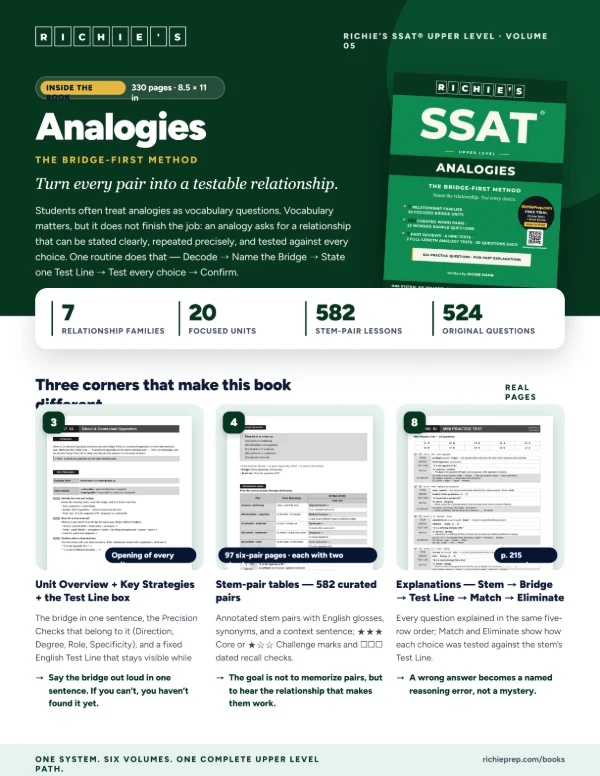
Seven relationship families organize twenty focused units — 582 curated stem pairs, each marked Core or Challenge, placed where their logic is easiest to learn.
Decode the stem, name the Bridge, state one Test Line, test every choice against the same sentence, and confirm the exact match.
English remains the language of the problem, while concise English glosses make the core relationship immediately checkable.
Each of the 524 explanations presents the evidence in one fixed order — Stem, Bridge, Test Line, Match, Eliminate.
The RICHIE’S edge
Most analogy books show pairs. This book teaches the sentence that makes the pair work.
TABLE OF CONTENTS
Explore every unit, then see how the pages help you put it into practice.
Name the relationship and test the same sentence against every pair.
At a glance
Bridge-First Thinking · Test Lines · Smart Elimination
Each Practice Test — 30 questions · three difficulty zones (A / B / C) · five choices (A–E)
Inside the Book
Preview real pages and see how each part supports your study.
1LEARN
Learn the stem-and-choice format, the purpose of a relationship bridge, and the types you will practice across the book’s seven families.
Know what the analogy is asking you to match.
2STRATEGY
Choose among three approaches based on which words you know. Decode the stem, name the bridge, write a Test Line, and check every choice.
Use a consistent routine even with unfamiliar words.
3LEARN
Each unit states the relationship, its direction, and the precision checks that matter. A short Test Line gives you a repeatable comparison.
Keep the relationship precise while comparing pairs.
4LEARN
Study pairs with meanings and contextual examples. Compare how the same bridge appears in different words, then check your recall.
Recognize the relationship across different vocabulary.
5MODEL
Follow a sample question from the stem’s meaning to the Test Line. Elimination notes show how each competing pair succeeds or fails.
See why a tempting pair does not fit.
6PRACTICE
Apply each bridge in unit exercises, then revisit learned types in six short mixed tests. Keep the Test Line precise as the vocabulary changes.
Choose the relationship without a unit label.
7TRANSFER
Complete a mixed review at the end of each relationship family. Compare neighboring bridge types before moving to the next part.
Separate relationships that are easy to confuse.
8REHEARSE
Bring the relationship families together in two 30-question tests. Use the book’s 15-minute training target to practice choosing under time pressure.
Apply the bridge method across a full practice set.
9REVIEW
Review each question through Stem, Bridge, Test Line, Match, and Eliminate. Trace the wrong choice to its meaning or relationship mismatch.
Know which reasoning step to practice again.
4 of 9 sample pages shown
Now available on Amazon
View available formats and current pricing on Amazon.
How to use this book
Do not reread the choices first. Recheck both stem meanings, say the Test Line aloud, name the bridge of the choice you picked, find the Precision Check you skipped — Direction, Degree, Role, or Specificity — and retest the item tomorrow without looking at the answer.
Study plan
When time is short, prioritize core bridge families, then finish with mixed review and section tests.
Where this book strikes
This volume trains the 30 analogy questions in the Verbal section.
Book Intro · 2-page PDF
The method, three standout corners from the real book, the study plans, and how to start.
PDF · 2 pages · 1.8 MB
Download the Book Intro (PDF)Word Lists & Tests
20 Units · 594 must-know words chosen from the book’s stem pairs and exercises
2026 Edition · v1.0
US Letter · prints on A4 with “Fit to page.”
| Unit | Word List | Test Form A | Test Form B | All three |
|---|---|---|---|---|
| Unit 01 · Direct & Contextual Opposites | 1 p | 1 p | 2 pp | 4 pp |
| Unit 02 · Absence, Prevention & Removal | 1 p | 1 p | 2 pp | 4 pp |
| Unit 03 · Degree & Intensity | 1 p | 1 p | 2 pp | 4 pp |
| Unit 04 · Synonym & Restatement | 1 p | 1 p | 2 pp | 4 pp |
| Unit 05 · Defining Traits & Attributes | 1 p | 1 p | 2 pp | 4 pp |
| Unit 06 · Field, Symbol & Specialized Definition | 1 p | 1 p | 2 pp | 4 pp |
| Unit 07 · Cause → Effect | 1 p | 1 p | 2 pp | 4 pp |
| Unit 08 · Action → Result / Product | 1 p | 1 p | 2 pp | 4 pp |
| Unit 09 · Problem → Response / Protection | 1 p | 1 p | 2 pp | 4 pp |
| Unit 10 · Tool / Object → Function & Purpose | 1 p | 1 p | 2 pp | 4 pp |
| Unit 11 · Location, Container & Spatial Relations | 1 p | 1 p | 2 pp | 4 pp |
| Unit 12 · Category ↔ Member | 1 p | 1 p | 2 pp | 4 pp |
| Unit 13 · Collective → Member | 1 p | 1 p | 2 pp | 4 pp |
| Unit 14 · Part → Whole / System / Material | 1 p | 1 p | 2 pp | 4 pp |
| Unit 15 · Agent / Role → Action / Product | 1 p | 1 p | 2 pp | 4 pp |
| Unit 16 · Specialist / Role → Subject / Workplace | 1 p | 1 p | 2 pp | 4 pp |
| Unit 17 · Agent ↔ Tool / Material / Counterpart | 1 p | 1 p | 2 pp | 4 pp |
| Unit 18 · Manner & Sensory Relations | 1 p | 1 p | 2 pp | 4 pp |
| Unit 19 · Stage & Sequence | 1 p | 1 p | 2 pp | 4 pp |
| Unit 20 · Quality → Possible Action / Effect | 1 p | 1 p | 2 pp | 4 pp |
PART 1 · CONTRAST & DEGREE
Free for owners of this book. Print copies for your own study, or for students in your class who use this book. Please don't repost these files or sell them. © Richie's Educational Research Institute.
No corrections yet for this edition. Found one? Write to errata@richieprep.com.
Start here
Finish Synonyms first, then use Analogies to apply word knowledge to relationship reasoning.
Get the Book Extras →Free SSAT Half-Length Test — 75 questions + writing sample, four timed sections. Marked the moment you submit; every question explained. No account, no card.
Ten full-length timed SSAT tests online — 166 questions + writing sample each, scored the SSAT way (+1 · 0 · −¼), with a practice report that names the two or three skills to study next.
Five minutes a day on the free Word Game keeps the words moving between tests.
One System. Six Volumes. One Complete Upper Level Path.


